Skip to content
Menu

Simple affiliate tracking software: is it worth it?

By OfferStack Editorial. Prices read from each vendor's own pricing page. Updated 15 September 2026.

Quick answer

Simple affiliate tracking software is our top pick for most people. Yes, it is real and low-risk to buy. Simple affiliate tracking software is a mature category of hosted tools that run your own affiliate program without an enterprise contract. For subscription SaaS, look at Rewardful; for a Shopify store, Refersion; for a flat fee across any stack, Tapfiliate. The regret is almost always the pricing model, not the software.

  • Simple affiliate tracking software. Best for Small teams running their own affiliate program. From $39/mo.

What you are actually asking

You typed "simple affiliate tracking software" into a search box because someone told you to start an affiliate program, and you want the least complicated way to do it. The first question is fair: is this a real thing to buy, or a phrase invented to sell you something?

It is real. It is a category, not a single app. It covers the hosted tools that let a small business recruit affiliates, track the sales they refer, and pay commissions, without an enterprise contract or a developer on staff. The names you will meet first are Rewardful, Refersion and Tapfiliate, and each is genuinely quick to stand up.

One thing to clear up early: this is affiliate program tracking, the software you run to manage your own partners. It is not the ad-click attribution that media buyers mean by "tracking" (RedTrack, Voluum and the like). Different job, different tools.

The regret, when there is one, rarely comes from the software. It comes from two places: paying a monthly fee before you have any affiliates, and picking a pricing model that gets expensive as the program grows. This review is about avoiding both.

Pros and cons

What works

  • It is a real, mature category. Rewardful, Refersion and Tapfiliate have years of updates and thousands of paying customers, so you are not betting on a one-person tool.
  • Setup is genuinely fast. Rewardful reports 15 to 20 minute installs, and none of these tools needs a developer to launch a basic program.
  • You own the affiliate relationship and the payout data instead of running the program from a spreadsheet, with first-party tracking that survives cookie loss.
  • Pricing is published and you can start small. Paid plans begin at $39 to $89 a month, most with a 7 to 14 day trial.

What to watch

  • The software does not recruit affiliates. It is an empty program until you bring partners, and many buyers regret paying $49 to $99 a month before anyone has sold.
  • Percentage-of-sales pricing stacks up. Refersion adds 2 to 3 percent of affiliate-driven sales on top of the commission you already pay, and it grows with the program.
  • The simple tools are narrow. Rewardful works only with Stripe or Paddle, and Refersion is built for Shopify and ecommerce. Pick the wrong one for your billing and tracking breaks.
  • Trials auto-convert. Each of these bills automatically when the free trial ends, so a card you add to test gets charged if you forget to cancel.

What the simple tools look like

Three tools cover most of this category, split by where your money is collected.

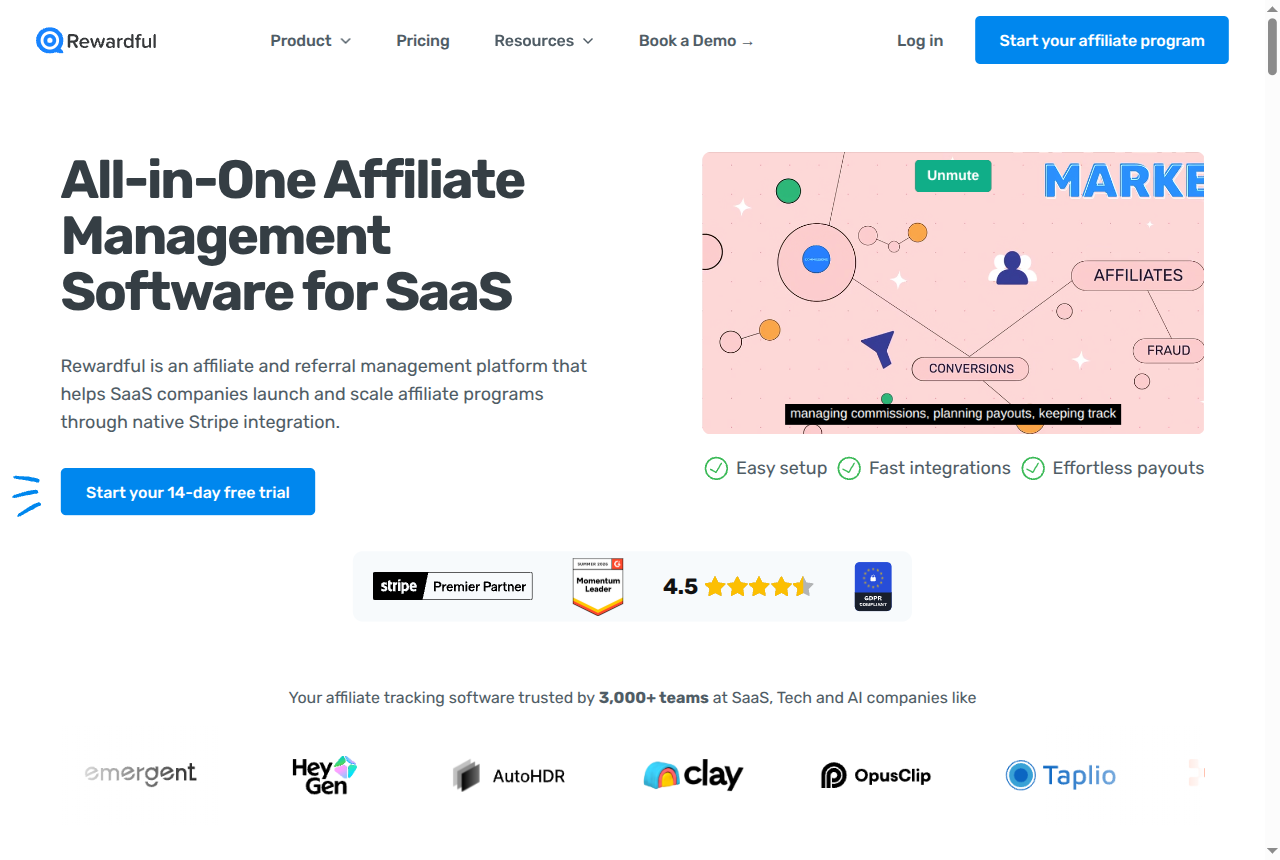
Rewardful home page: affiliate and referral software built on Stripe and Paddle billing.
Rewardful builds an affiliate program on top of Stripe or Paddle, which makes it the simplest fit for subscription SaaS. Source: rewardful.com.
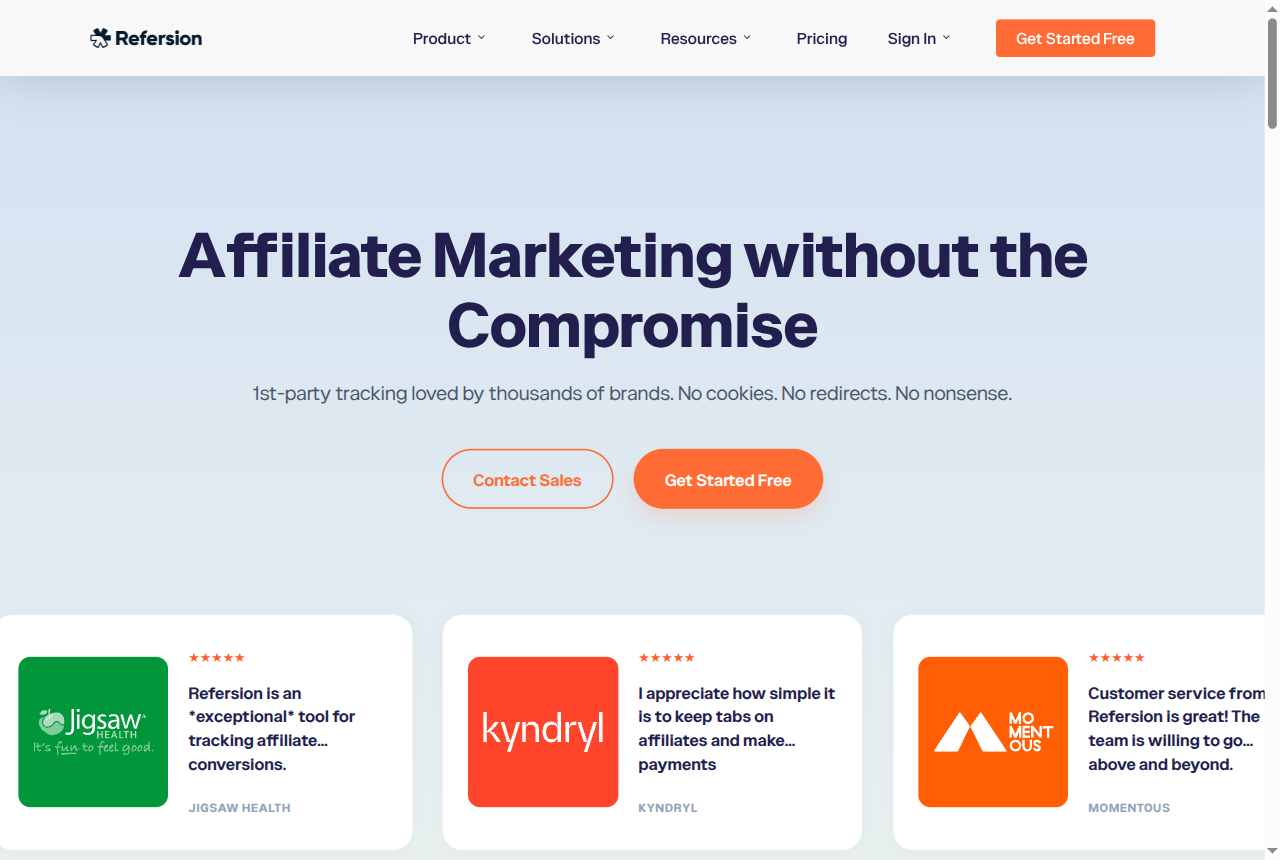
Refersion home page: affiliate tracking and attribution designed for ecommerce brands and merchants.
Refersion installs into Shopify and other stores with a first-party tracking domain, reading the store's own order data. Source: refersion.com.
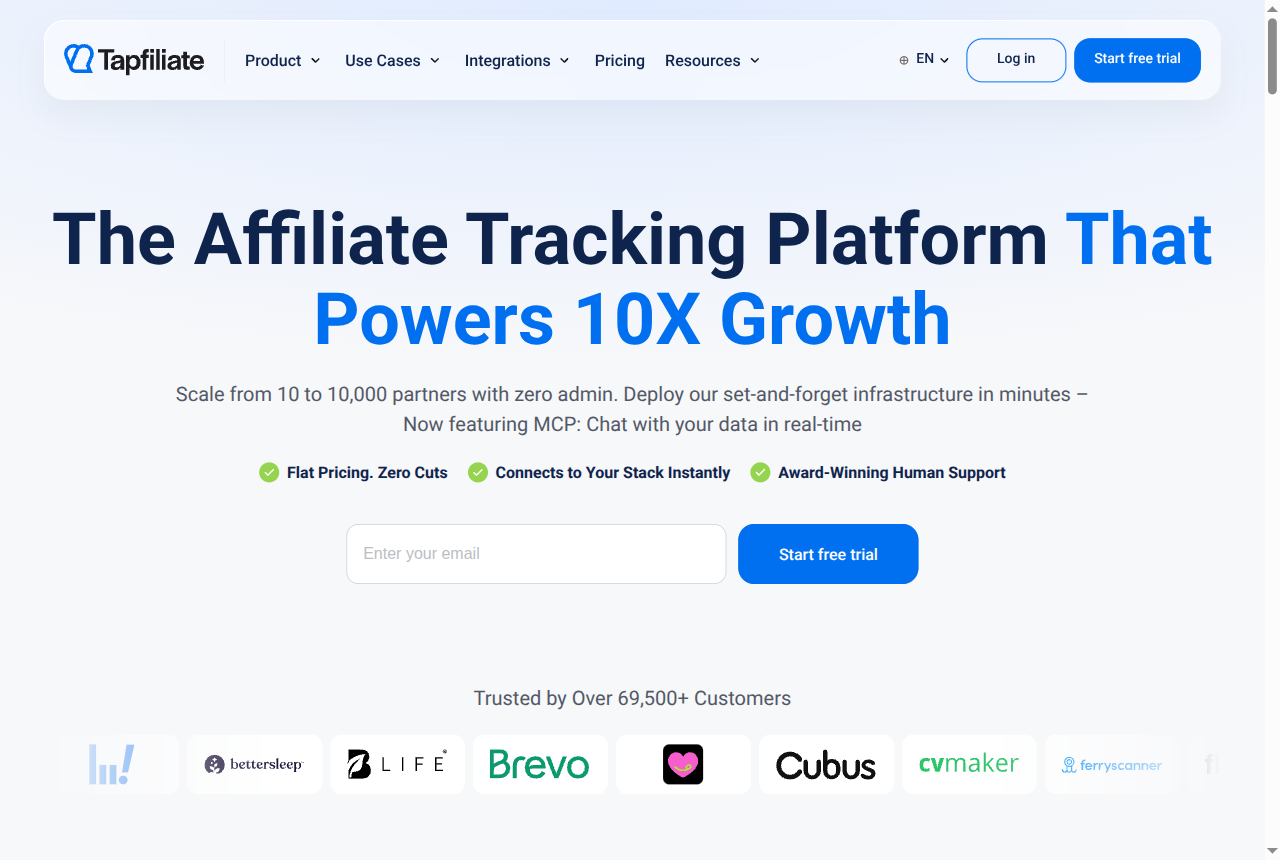
Tapfiliate home page: affiliate marketing software with integrations, an API and postback tracking.
Tapfiliate spans SaaS and ecommerce through 30-plus integrations, a pixel, an API and postbacks, on a flat fee with no cut of your sales. Source: tapfiliate.com.

What buyers keep saying

Research:

The pricing model is the real decision, not the software

The regret buyers report is almost never the tracking. It is the pricing model. Refersion charges a monthly fee plus a percentage of affiliate-driven sales, which stacks on top of the commission you already pay and grows as the program grows. Flat-fee tools like Tapfiliate trade that for usage caps and per-thousand overage. Pick the model that stays cheap at the affiliate revenue you actually expect.

“There are no extra or hidden setup fees.”

Tapfiliate Blog: Tapfiliate pricing FAQ

“You're only charged a percentage of affiliate-driven sales”

Refersion Blog: Refersion pricing page

“Is it just me, or is the price for some apps getting obscene?”

r/shopify Reddit: Shopify app pricing thread

The software will not recruit affiliates for you

Every tool here tracks referrals and pays commissions. None of them finds partners. Operators repeatedly regret paying $49 to $99 a month before a single affiliate has sold anything, and often start with manual discount codes until the channel proves itself.

“Stripe-native alternative to Rewardful/Tolt for micro-SaaS, free until your first affiliate”

r/microsaas Reddit: Micro-SaaS affiliate tooling thread

“Which affiliate program service provider do you use?”

r/indiehackers Reddit: Which affiliate provider do you use

Match the tool to where you collect payment ↑ frequently praised

Rewardful works only with Stripe or Paddle and is built for subscription SaaS. Refersion installs into Shopify and other stores with first-party tracking. Tapfiliate spans both through 30-plus integrations, a pixel, an API and server-to-server postbacks. The right pick follows your billing platform, not a feature checklist.

“Not at this time. We currently support only Stripe or Paddle.”

Rewardful Blog: Rewardful pricing FAQ

“There are no extra or hidden setup fees.”

Tapfiliate Blog: Tapfiliate pricing FAQ

“First-party tracking domain (no cookies)”

Refersion Blog: Refersion Launch plan

Setup is genuinely fast, and trials auto convert

For a simple program, onboarding is not the hard part. Rewardful reports 15 to 20 minute installs and Tapfiliate charges no setup fee. The catch is that free trials convert to paid automatically, so a card added to test can be billed if you forget to cancel.

“All plans come with a 14-day free trial.”

Rewardful Blog: Rewardful pricing page

“We've seen it take companies about 15-20 minutes, on average.”

Rewardful Blog: Rewardful install time

“After your free trial (7, 14, or 30 days, depending on the plan) ends, your subscription starts automatically and billing begins.”

Tapfiliate Blog: Tapfiliate trial terms

“All plans come with a 14-day free trial.”

Rewardful Blog: Rewardful pricing page

“Not at this time. We currently support only Stripe or Paddle.”

Rewardful Blog: Rewardful pricing FAQ

“We've seen it take companies about 15-20 minutes, on average.”

Rewardful Blog: Rewardful install time

“There are no extra or hidden setup fees.”

Tapfiliate Blog: Tapfiliate pricing FAQ

“After your free trial (7, 14, or 30 days, depending on the plan) ends, your subscription starts automatically and billing begins.”

Tapfiliate Blog: Tapfiliate trial terms

“You're only charged a percentage of affiliate-driven sales”

Refersion Blog: Refersion pricing page

“First-party tracking domain (no cookies)”

Refersion Blog: Refersion Launch plan

“Is it just me, or is the price for some apps getting obscene?”

r/shopify Reddit: Shopify app pricing thread

“Stripe-native alternative to Rewardful/Tolt for micro-SaaS, free until your first affiliate”

r/microsaas Reddit: Micro-SaaS affiliate tooling thread

“Which affiliate program service provider do you use?”

r/indiehackers Reddit: Which affiliate provider do you use

“Launch Your Affiliate Program in 3 Simple Steps”

Tapfiliate Blog: Tapfiliate home page

“Pre-built connectors for Shopify, WooCommerce, Squarespace, Wix, BigCommerce, Stripe, Paddle and 30+ others install in <10 min. If you’re on a custom site, drop in the JS snippet or call the REST API.”

Tapfiliate Blog: Tapfiliate setup FAQ

“Campaigns: How to setup and manage your campaigns and commission structures.”

Rewardful Blog: Rewardful Help Center

One voice for, one against

For. On the Shopify App Store, Refersion holds roughly 4.8 out of 5 across about 500 merchant reviews, where the recurring praise is fast setup and tracking that just keeps working. Aggregate scores on GetApp and Trustpilot for Tapfiliate land in the same 4.3 to 4.5 range. For a category people worry is fly-by-night, that is a reassuring floor.

Against. The loudest complaint is cost, and it is about the model, not the sticker. A Shopify merchant thread titled "Is it just me, or is the price for some apps getting obscene?" captures the frustration with apps that charge a monthly fee and a cut of sales. On the SaaS side, an r/microsaas thread was built entirely around wanting something "free until your first affiliate", because $49 to $99 a month before any partner has sold stings.

What each one costs

Rewardful. $49 a month (Starter) covers up to $7,500 a month in affiliate-generated revenue; $99 (Growth) up to $15,000; $149 and up (Enterprise) above that. Zero transaction fee, Stripe or Paddle only, 14-day trial.

Tapfiliate. $89 a month (Launch) with 50 affiliates, 5,000 clicks and 500 conversions, then $1.50 per 1,000 extra clicks and $15 per 1,000 extra conversions; $179 (Scale) lifts the caps and unlocks unlimited affiliates and programs. No cut of your sales. Trials run 7 to 30 days by plan and convert to paid automatically.

Refersion. A free marketplace listing, then $39 a month (Launch) plus 3 percent of affiliate-driven sales, or $199 (Growth) plus 2 percent. The flat-fee Scale plan is reserved for brands over $1M GMV. Unlimited affiliates and conversions on every paid plan, with first-party tracking and no cookies.

The percentage is the thing to model. On Refersion, Launch and Growth cost the same at about $16,000 a month in affiliate sales ($39 plus 3 percent versus $199 plus 2 percent); below that Launch is cheaper, above it Growth is. And the 2 to 3 percent sits on top of the 10 to 20 percent commission you already pay affiliates, so $10,000 of affiliate sales at a 15 percent commission runs about $1,839 all-in, close to 18 percent of that revenue. A flat-fee tool removes the percentage but caps your usage instead.

Prices read from each vendor's own pricing page, current as of 14 September 2026. Check the vendor before you buy; plans change.
How to set it up, step by step

Setting up simple affiliate tracking software is a fixed, seven-step sequence: connect your billing platform, set the commission, add the margin guards, build the sign-up page, recruit partners, test one referral, then connect payouts. For a basic program it is an afternoon of work, not a project.

Every tool here runs the same order. Tapfiliate frames its own version as "Launch Your Affiliate Program in 3 Simple Steps". The extra steps below are the ones that decide whether the program is actually safe to open to real partners.

  1. Connect where the money is collected. Attach the tool to your checkout so it reads real order data, not a pixel that can miss. Rewardful connects to Stripe or Paddle and reports a 15 to 20 minute install. Refersion installs into Shopify and reads the store's own orders. Tapfiliate offers "pre-built connectors for Shopify, WooCommerce, Squarespace, Wix, BigCommerce, Stripe, Paddle and 30+ others [that] install in <10 min", or a JS snippet and a REST API for a custom site. Pick the integration that matches your billing before you touch anything else.
  2. Create a campaign and set the commission. This is where you decide what a referral is worth. You can set a percentage, a fixed amount, or tiered rates, and for a subscription a recurring commission that keeps paying on renewals. Set the cookie window too: how long after a click a sale still counts toward the affiliate. Decide these before anyone joins, because changing them later means renegotiating with live partners.
  3. Add the guards that protect your margin. Turn on self-referral blocking so an affiliate cannot buy through their own link and pocket the commission. Exclude existing customers or specific coupon codes if you do not want to pay on sales you would have made anyway. Decide how a refund or chargeback reverses a commission. These settings are the difference between a program that pays for itself and one that quietly leaks.
  4. Build the sign-up page and write the terms. Each tool gives you a hosted, white-label sign-up page and affiliate dashboard you can put your own logo and colours on. Write plain program terms next to it: the commission, the cookie window, what is and is not commissionable, when and how you pay, and the grounds for removal. Affiliates read this before they agree to promote you.
  5. Recruit the partners yourself. The software will not find affiliates for you, and this is the one setup truth people learn too late. Invite existing customers, reach out to creators and niche sites, and for partners who sell off-platform on Instagram, TikTok or by word of mouth, issue unique coupon codes so the sale is tracked even without a click.
  6. Test one referral end to end before you announce. Sign up as your own test affiliate, click the referral link, and run a real or test purchase through checkout. Confirm the click, the conversion and the commission all show up in the dashboard, and that a refund reverses the commission. A program that miscounts on day one burns trust with the affiliates you just recruited.
  7. Connect payouts and collect tax details. Decide how you pay: a managed payout feature, PayPal mass payments, or a manual transfer. Set a payout schedule and a minimum threshold, and collect the tax forms you are required to (a W-9 or W-8 for a US program) before the first payment, not after it.

Setup mistakes that cost you later

  • Paying before you have affiliates. The monthly fee starts whether or not a partner has sold. With only a handful of partners, unique discount codes can hold you until the channel proves itself.
  • Launching without the self-referral guard. Leave it off and affiliates can earn commission on their own purchases.
  • A cookie window left on the default. Too short and you underpay real referrers. Too long and you pay for sales the affiliate did not drive. Match it to your sales cycle.
  • Skipping the end-to-end test. It is the step people cut, and the one that catches a broken integration before your affiliates do.

Still weighing the standalone platform against the store app before you start? We break that choice down in simple affiliate tracking software versus an app, and the running cost in what it actually costs.

Changelog

  • 15 September 2026 — Added a step-by-step setup walkthrough for standing up a program on Rewardful, Refersion or Tapfiliate, plus a setup FAQ. Steps checked against Tapfiliate's and Rewardful's own documentation.
  • 15 September 2026 — First published. Rewardful, Tapfiliate and Refersion pricing verified against each vendor's own pricing page.

Frequently asked questions

Is 'simple affiliate tracking software' a real product or just a search term?
It is a category, not one product. It refers to hosted tools such as Rewardful, Refersion and Tapfiliate that let a small business run its own affiliate program, track referred sales and pay commissions, without an enterprise contract.
Will I regret buying it?
The software is rarely the regret. The two common ones are paying a monthly fee before you have any affiliates, and choosing a percentage-of-sales plan that gets expensive as the program grows.
What does it cost?
Paid plans start around $39 to $89 a month. Some add a percentage of affiliate-driven sales (Refersion adds 2 to 3 percent); others charge a flat fee with usage caps (Tapfiliate) or affiliate-revenue tiers (Rewardful). Prices verified 14 September 2026.
Which one is simplest for me?
For Stripe or Paddle SaaS, Rewardful. For Shopify and ecommerce, Refersion. For a flat fee across any stack, Tapfiliate. Match it to where you collect payment.
Do I need it if I only have a few affiliates?
Often not yet. Below a handful of affiliates, unique discount codes or manual tracking can cover it until the program proves it can drive real sales.
How do I set up affiliate tracking software?
Connect the tool to where you collect payment (Stripe or Paddle for Rewardful, your Shopify store for Refersion, or one of Tapfiliate's 30-plus integrations or its snippet), create a campaign and set the commission and cookie window, turn on self-referral blocking, build your sign-up page and terms, recruit affiliates yourself, test one referral end to end, then connect payouts. For a simple program it is an afternoon of work, not a project.

Sources

Other sources

13 discussions and reviews read for this page. Quotes are excerpts; open a link to read the original in context.

  1. [rewardful-trial] Rewardful pricing page Blog
  2. [rewardful-stripe] Rewardful pricing FAQ Blog
  3. [rewardful-setup] Rewardful install time Blog
  4. [tapfiliate-setup] Tapfiliate pricing FAQ Blog
  5. [tapfiliate-autobill] Tapfiliate trial terms Blog
  6. [refersion-fee] Refersion pricing page Blog
  7. [refersion-firstparty] Refersion Launch plan Blog
  8. [reddit-shopify-appprices] Shopify app pricing thread Reddit
  9. [reddit-microsaas-empty] Micro-SaaS affiliate tooling thread Reddit
  10. [reddit-indie-provider] Which affiliate provider do you use Reddit
  11. [tapfiliate-3steps] Tapfiliate home page Blog
  12. [tapfiliate-install] Tapfiliate setup FAQ Blog
  13. [rewardful-campaigns] Rewardful Help Center Blog

Where to go next

If you have narrowed it to the two models, the standalone platform versus the store app, we break that choice down side by side in simple affiliate tracking software versus an app.

Related reading

Written by

OfferStack Editorial

Editorial desk

OfferStack Editorial is the desk behind the site's reviews and rankings. We read long-term operator reports, vendor documentation and pricing pages, verify every price against the source, and update the money pages on a fixed schedule. Where a call needs first-hand testing we say so plainly.

Last checked 2026-09-15