Skip to content
Menu

The best ad tracking and attribution software for direct-response operators

By Marcus Flynn, tracking and attribution editor. Reviewed by the OfferStack desk. Updated 15 September 2026.

Every ad platform tells you it drove the sale. Run traffic across two of them and they will each claim the same conversion, while none of them sees the opt-in, the email, or the call that actually closed it. An attribution tool exists to give you one set of numbers you own, and to feed clean conversions back so the platforms optimize on real outcomes instead of their own guesses.

We looked at the trackers direct-response operators actually run at spend. The ranking below is ordered by how well each one fits the most common situation, not by a score we then have to defend. Prices were read from each vendor's own pricing page on 14 September 2026.

Quick answer

RedTrack is our top pick for most people. The default first tracker for most direct-response buyers: CAPI on every plan, ad-level spend sync, and an entry price a solo operator can carry.

  • RedTrack. Best for Multi-channel paid-social buyers. From $69/mo.
  • Voluum. Best for Affiliate and native/pop/push buyers. From $119/mo.
  • Hyros. Best for High-ticket info, webinar and call funnels.

Compare at a glance

The differences that decide it: server-side conversion tracking, a built-in anti-fraud kit, and whether you host it yourself.

Feature comparison across 3 tools
Tool Server-side CAPI Anti-fraud kit Self-hosted From
1. RedTrack Yes ×No ×No $69/mo
2. Voluum limited Yes ×No $119/mo
3. Hyros Yes Unknown ×No Not listed

The ranked picks

1. RedTrack

Performance-marketing analytics with ad tracking, attribution and CAPI in one place.
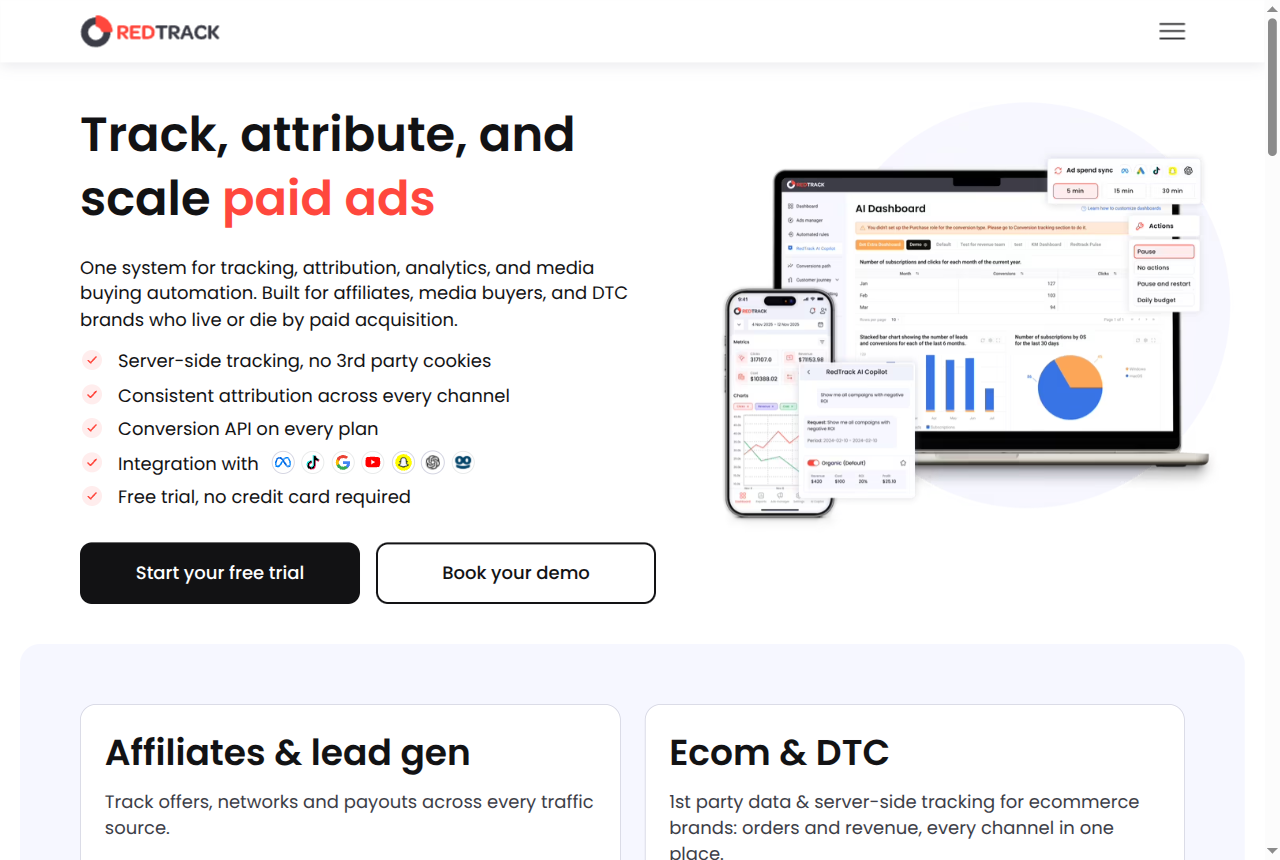
RedTrack home page headline offering performance-marketing analytics with tracking, attribution and CAPI.

Our take: The default first tracker for most direct-response buyers: CAPI on every plan, ad-level spend sync, and an entry price a solo operator can carry.

What works

  • Server-side CAPI for Meta, TikTok, Google and Snapchat is included from the $69 Builder plan, where several rivals gate it behind four-figure tiers.
  • Ad-spend sync down to the ad level means ROAS and CPA reflect what was actually spent, not a number hours out of date.
  • Sits between a pure click tracker and a revenue-attribution suite, so one tool covers affiliate offers and owned DTC.
  • Published, tiered pricing all the way up to Agency, so you can forecast cost as you scale seats and events.

What to watch

  • The fresh ad-spend sync speeds (5 and 15 minute) and the Ads Manager control layer are paid add-ons on top of the plan, so the real monthly cost at scale runs above the headline price.
  • It is a media-buying tracker, not a full multi-touch attribution suite for long, call-heavy sales cycles; buyers who need that look at Hyros.
  • Setup still asks for clean UTMs, working pixels and CAPI hygiene. It surfaces tracking gaps, it does not paper over them.
Price
$69/mo
Best for
Multi-channel paid-social buyers

2. Voluum

Cloud ad tracker for affiliate and media-buying campaigns.

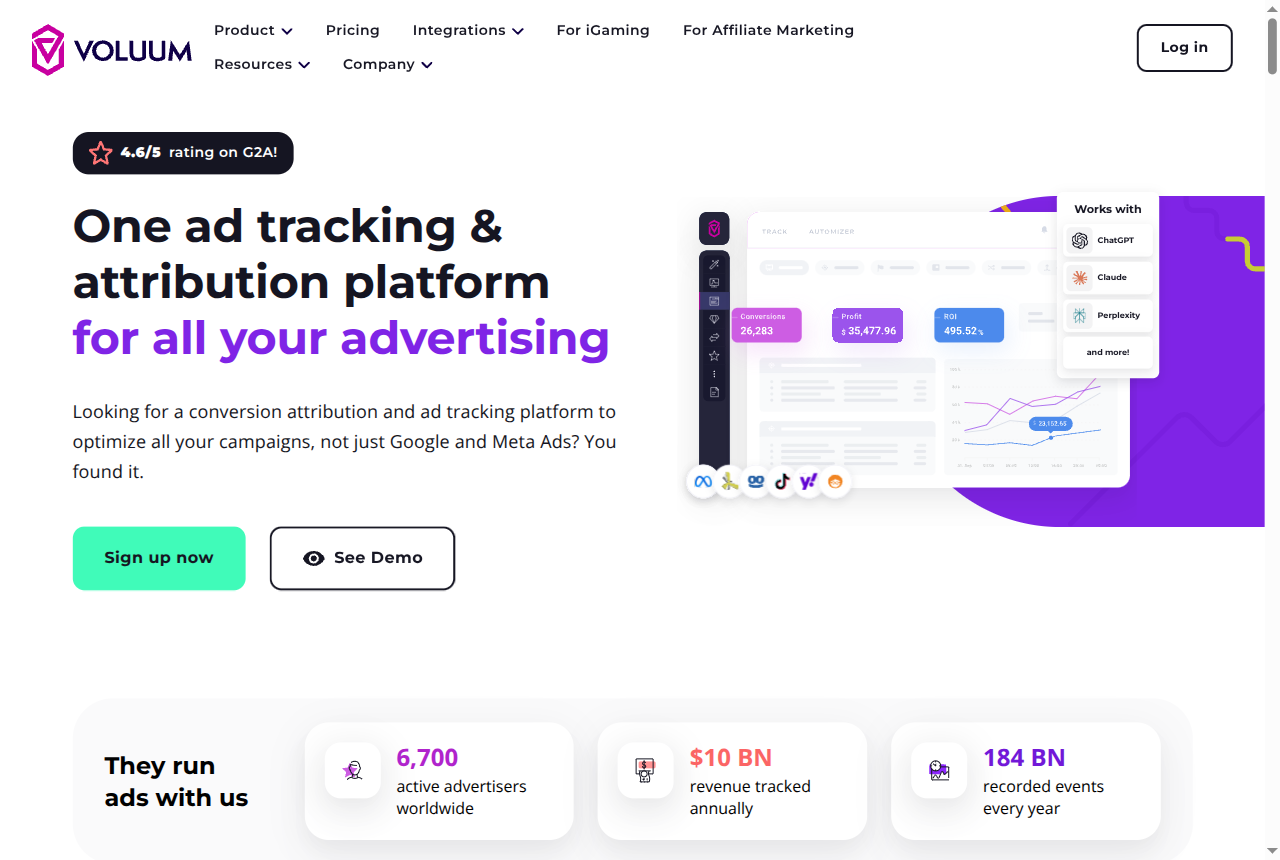
Voluum home page describing an ad tracker for media buyers with campaign optimization and anti-fraud.

Our take: The veteran affiliate and media-buying tracker: click routing, S2S postbacks, cookieless tracking and a strong anti-fraud kit, priced for buyers who live in native, pop and push.

What works

  • Deep click-routing and traffic-distribution rules built for zone, publisher, GEO, device and sub-ID optimization.
  • Cookieless tracking and S2S postbacks that hold up on redirect-style affiliate flows where browser pixels fail.
  • The Anti-Fraud Kit flags suspicious traffic automatically, which matters most on native and pop inventory.
  • Cloud-hosted with automatic migration from an old tracker, so there is no server to run.

What to watch

  • The automation layer, Automizer, is billed separately from $375/mo on top of the plan, so real automation costs stack fast.
  • Full server-side CAPI depth and higher event ceilings sit on the expensive upper tiers ($539 to $1,599/mo).
  • It is built around click routing and offer/lander optimization more than ecommerce customer-journey attribution.
Price
$119/mo
Best for
Affiliate and native/pop/push buyers

3. Hyros

Multi-touch ad attribution for high-ticket, long-cycle funnels.

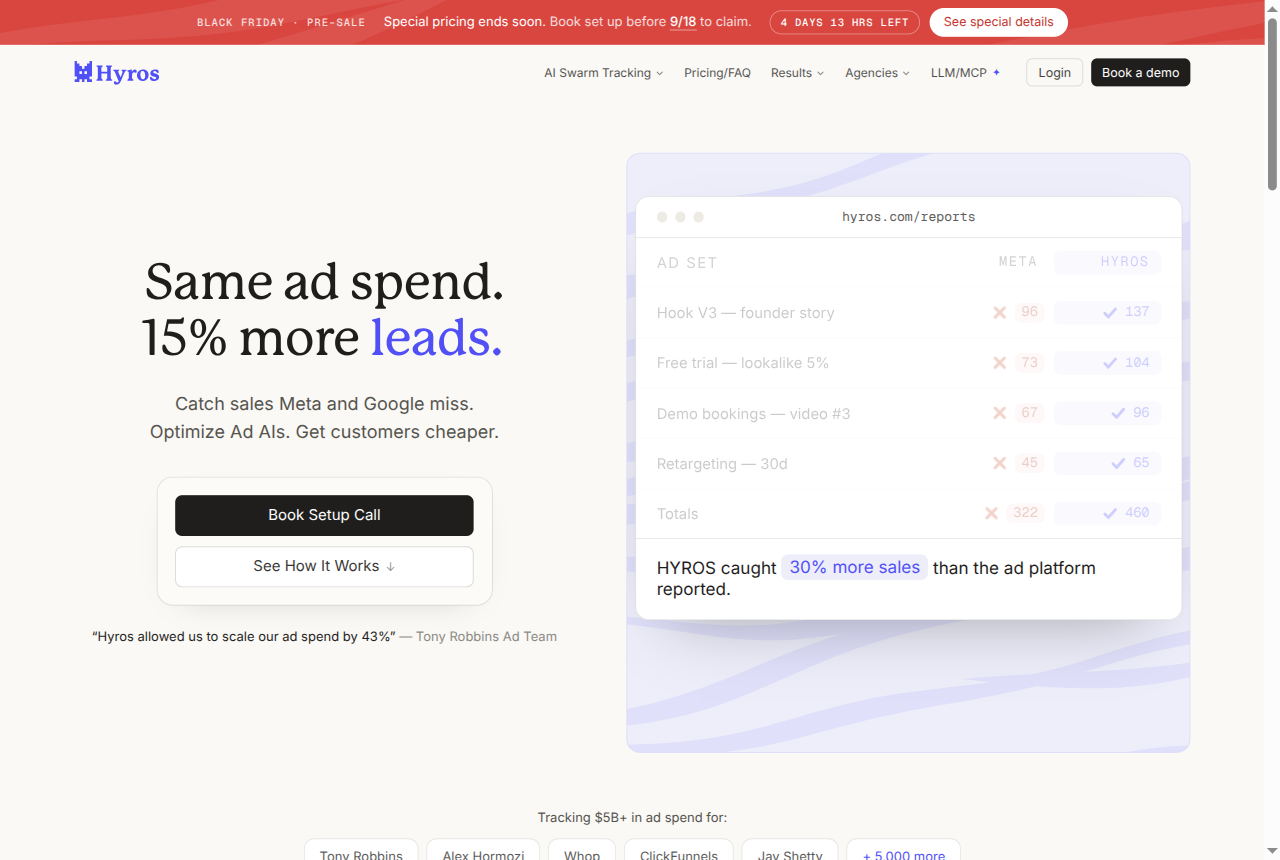
Hyros home page claiming the same ad spend with 15 percent more sales through ad tracking and attribution.

Our take: The revenue-attribution layer for high-ticket, long-cycle funnels: it stitches multi-touch journeys and feeds real sales back to the ad platforms, and it is priced and set up accordingly.

What works

  • Multi-touch attribution across a long journey (ad to opt-in to email to webinar to booked call), which last-click platforms miss.
  • Sends offline and long-window sales back to Meta and Google so their algorithms optimize on real revenue.
  • Call and high-ticket tracking is a first-class use case, not an afterthought, with named case studies from large info brands.

What to watch

  • Hyros does not publish plan prices; cost is quoted after a demo and is aimed at higher-spend accounts, so it is opaque before a sales call.
  • Operators repeatedly report it is involved to set up and overkill below roughly $50k/month in spend across multiple platforms.
  • It will not fix low Event Match Quality or a weak offer; it makes the attribution clearer, not the funnel better.
Price
Not listed
Best for
High-ticket info, webinar and call funnels

Best by traffic type, with a runner-up

Which tracker fits depends on where your traffic comes from more than on any single feature. Each audience below has a winner and a runner-up, so you have a fallback when the first pick does not fit your budget or your stack.

Affiliate marketing across networks (pop, push, native, redirect offers). Voluum is the pick if you promote many offers and landers across affiliate networks and want S2S postbacks, sub-ID pass-through and an anti-fraud kit in one managed place. It is built around click routing and offer rotation rather than a single owned funnel, which is exactly the affiliate media-buyer's shape. Runner-up: a self-hosted tracker such as Keitaro or Binom, once your click volume is high enough that per-event cloud pricing hurts. You take on the server, the updates and the SSL in exchange for flat per-license cost.

Affiliate marketing on paid social (Meta, TikTok, YouTube). RedTrack is the pick if most of your affiliate traffic is bought on the ad platforms and the conversion happens on your own pages, because server-side CAPI is included from the entry plan and ad-spend sync keeps the platforms optimizing when browser pixels drop. Runner-up: Voluum, if you also route redirect-style offers and would rather run one tracker for both sides.

Owned DTC and lead-gen on paid social. RedTrack again, for the same reason, plus published tiered pricing you can forecast as you add seats and events. Runner-up: Voluum, once fraud filtering on native or display inventory becomes the deciding factor.

High-ticket, webinar and call funnels. Hyros is the pick for multi-touch attribution across a long journey, with offline and booked-call revenue fed back to the platforms. Runner-up: RedTrack, when the funnel is shorter and the budget is tighter.

What to avoid

  • Buying Hyros under about $50k a month in spend. The setup and cost outrun the value at that level. Clean CAPI plus a cheaper tracker covers most of it.
  • Stacking Voluum's Automizer before you need automation. It is billed separately from $375 a month and doubles the real bill fast.
  • Expecting any tracker to rescue a weak offer. These tools make the leak visible. They do not patch it.

How we evaluated these

We weighed five things, in this order: attribution accuracy and the depth of server-side conversion tracking; the real monthly cost at spend, including the add-ons vendors keep off the headline price; fit to your traffic type; whether you own your click and conversion data; and the quality of support when a pixel breaks mid-launch.

We did not run paid campaigns through each tool. We read each vendor's own documentation and pricing, and the long-term reports of operators who did. The full rubric is on the methodology page.

How to choose

Start from your traffic, not the feature list. If most of your spend is on Meta, TikTok or Google and your sale happens on your own pages, you want server-side CAPI and ad-spend sync, and you want it cheap enough to run from day one. If you buy native, pop or push and rotate many offers and landers, you want click routing, postbacks and fraud filtering. If your funnel runs ad to opt-in to webinar to booked call over weeks, you want multi-touch revenue attribution and you will pay for it.

Then check the real number. Add the automation layer, the faster spend sync, and the extra seats before you compare, because that is what you will actually pay at scale.

What is ad tracking and attribution software?

Ad tracking and attribution software connects an ad click to what happens next: the visit, the opt-in, and the sale, wherever it lands. It assigns credit across the touchpoints a buyer passed through, and it sends those conversions back to the ad platforms server-side, so their algorithms optimize on outcomes a browser pixel would have missed.

For a direct-response operator, that is the difference between scaling on numbers you trust and scaling on three platforms that each claim the same sale.

What "affiliate tracking software" means

Affiliate tracking software is software that ties a referral to the sale it produced, so the right source gets credited and paid automatically. The phrase carries two different meanings, and the tool you want depends on which side of the transaction you are on. Search results mix the two together, which is why so many buyers end up shortlisting products that cannot do the job they had in mind.

Sense one: a tracker for the campaigns an affiliate runs. When a media buyer promotes other people's offers and searches for "affiliate tracking software", they mean a click tracker for their own traffic. It stamps every click with a sub-ID, routes it to the right offer and landing page, records the conversion the network posts back over server-to-server (S2S), and reports profit per campaign, per placement and per traffic source. That is the category ranked on this page. Voluum, RedTrack and the self-hosted trackers Keitaro and Binom all live here.

Sense two: software for running your own affiliate program. When a merchant wants partners to sell for them, "affiliate tracking software" means the platform that gives each partner a unique link or coupon code, counts the clicks and sales it drives, calculates the commission, and handles payout. Tracking here is usually first-party or coupon-based rather than S2S, because the sale happens on the merchant's own checkout. Rewardful, Refersion and Tapfiliate are the common names. If that is the job you are hiring for, start with our guide to simple affiliate tracking software.

The two share a vocabulary and almost nothing else. A campaign tracker will not issue partner payouts, and a program platform will not optimize your Meta bidding. Decide which job you are hiring the software for before you compare prices, because picking the wrong category is the most expensive mistake in this space.

Frequently asked questions

Do I need a tracker if Meta and Google already report conversions?
Once you run across more than one platform or your sales happen off-site, the platforms each over-claim the same conversions and none of them see the full journey. A tracker gives you one set of numbers you own, and sends clean conversions back to each platform so their algorithms learn from real outcomes.
What is the cheapest tracker that still does server-side CAPI?
RedTrack includes server-side CAPI for Meta, TikTok, Google and Snapchat on its $69 Builder plan. Most rivals gate the same coverage behind far higher tiers, so on entry price it is the cheapest credible option for paid-social buyers.
At what ad spend does a dedicated attribution tool pay for itself?
Below roughly $10k to $20k a month, proper server-side events plus Meta CAPI and Google Enhanced Conversions cover most of the value. A paid tool earns its cost once tracking gaps get expensive, usually across multiple platforms or longer sales cycles.
Will any of these fix a bad conversion rate?
No. A tracker tells you where the money leaks. It cannot fix a weak offer, a broken pixel, or low Event Match Quality. Operators repeat this constantly, and it is the single most common mistake buyers make.
What is the best tracking software for affiliate marketing?
It depends on where the traffic comes from. Voluum is the pick if you promote offers across affiliate networks on pop, push, native or redirect traffic and need S2S postbacks and fraud filtering. RedTrack is the pick if your affiliate traffic is mostly paid social and you want server-side CAPI included cheaply. Once click volume is very high, a self-hosted tracker such as Keitaro or Binom is cheaper per event, if you can run the server.
What does affiliate tracking software mean?
The term has two meanings. For a media buyer promoting offers, it means a click tracker for their own campaigns, with sub-IDs, offer routing and server-to-server postbacks, which is the category ranked here. For a merchant, it means the platform that runs their own affiliate program, giving each partner a link or coupon code and paying commission. The two do not overlap, so decide which role you are in before you shortlist a tool.

Changelog

  • 15 September 2026 — Expanded the definition section to spell out what "affiliate tracking software" means, separating the campaign-tracker sense from the affiliate-program sense, and added a definitional FAQ.
  • 15 September 2026 — Expanded the by-traffic-type section with a winner and runner-up for affiliate marketers, split by network and paid-social traffic, and added an affiliate-marketing FAQ. Cross-referenced the separate category of affiliate program software.
  • 14 September 2026 — First published. Prices for all three tools verified against the vendor pricing pages.

Related reading

Marcus Flynn

Written by

Marcus Flynn

Tracking and attribution editor

Marcus Flynn runs OfferStack's tracking and attribution desk. He has spent years close to direct-response paid media, and he reads the operator threads, vendor changelogs and pricing pages so you do not have to, then writes down what holds up once real budget runs through it. He owns the methodology and signs the site's money pages.

Last checked 2026-09-15